SIBER - Sustained Indian Ocean Biogeochemistry and Ecosystem Research
SIBER is an international program co-sponsored by IMBeR (Integrated Marine Biosphere Research) and IOGOOS (Indian Ocean Global Ocean Observing System) that is focused on the Indian Ocean. The overarching goal of the SIBER program is to motivate and coordinate international interest in Indian Ocean research in order to improve our understanding of the role of the Indian Ocean in global biogeochemical cycles and the interaction between these cycles and marine ecosystem dynamics. This understanding will be required in order to predict the impacts of climate change, eutrophication and harvesting on the global oceans and the Earth System and it is fundamental to policy makers in the development of management strategies for the globally important Indian Ocean.
IIOE & SIBER LINKAGES
SIBER has played a pivotal role in initiation of plans to celebrate the 50th anniversary of the International Indian Ocean Expedition (IIOE). SIBER has also been instrumental in motivating international community to envision IIOE-2 as a 5 years expedition beginning in approximately 2015 and continuing through to 2020. Details on IIOE can be found at IIOE-2.
SIBER is a basin-scale international programme with a concerted effort to develop an enhanced understanding of the Indian Ocean and its role in the global biogeochemical cycle. This programme is intended to provide scientific guidance and potential research focus to many countries, including Indian Ocean rim countries, interested in pursuing research activities in the Indian Ocean. The long-term goal of SIBER is to understand the role of the Indian Ocean in global biogeochemical cycles and the interaction between these cycles and marine ecosystem dynamics. The coordination and integration of Indian Ocean biogeochemical and ecosystem research through SIBER will advance our knowledge of this under-sampled basin and provide a major contribution to the understanding of how regional and global change may impact biogeochemical cycles and ecosystem function, not only in the Indian Ocean, but in the Earth System, creating a lasting legacy upon which future research can be built. The scientific findings will inform scientists in the international community and provide a focus for future research on important regional, basin-wide, and global issues. These findings will also provide policy makers with the sound scientific basis upon which to make decisions on the management of Indian Ocean ecosystems. SIBER will leverage and strengthen GOOS and IMBER by promoting coordinated international, multidisciplinary research in developed countries, and also human resources and infrastructure development in many developing Indian Ocean rim countries.
SIBER Linkages:
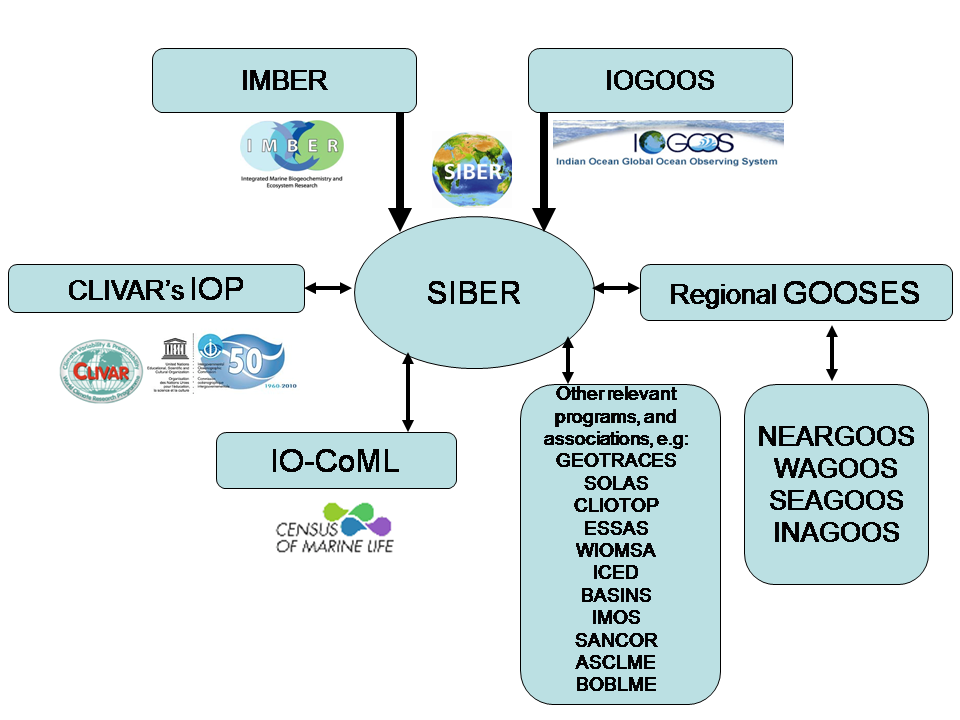
SIBER has been developed under the Integrated Marine Biogeochemistry and Ecosystem Research (IMBER) project, and the Indian Ocean GOOS (IOGOOS) program with support from the Intergovernmental Oceanographic Commission (IOC). SIBER coordinates with international research efforts such as the IMBER regional programs: Climate Impacts on Oceanic Top Predators (CLIOTOP), Ecosystem Studies of Sub-Arctic Seas (ESSAS) and Integrating Climate and Ecosystem Dynamics in the Southern Ocean (ICED), and the International Study of Marine Biogeochemical Cycles of Trace Elements and their Isotopes (GEOTRACES). SIBER also leverages several coastal and open ocean monitoring programs in the Indian Ocean. These include the CLIVAR- and GOOS-sponsored Indian Ocean Observing System (IndOOS), Australia's Integrated Marine Observing System (IMOS) and several regional GOOS programs. To develop a broader understanding of the Indian Ocean ecosystem, SIBER coordinates its efforts with the Western Indian Ocean Marine Science Association (WIOMSA), the South African Network for Coastal and Oceanic Research (SANCOR), the Agulhas and Somali Current Large Marine Ecosystems project (ASCLME) and the Bay of Bengal Large Marine Ecosystem project (BOBLME). As SIBER developed, it's collaborations, the number of participants, institutes and programs involved have also increased. SIBER provides the innovation, direction and coordination required to build a critical mass of multidisciplinary science and scientists to deliver this ambitious but achievable and globally important program.
Oversights and responsibilities:
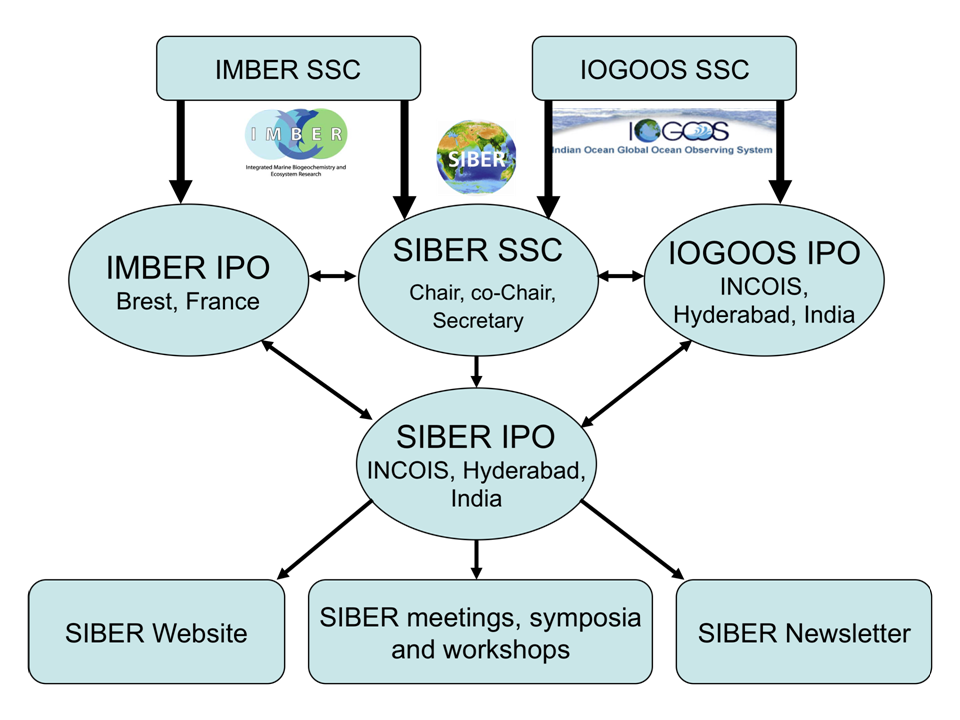
The schematic diagram given below illustrates the relationships between the SIBER International Project Office (IPO) and IMBER and IOGOOS IPOs, along with oversight and responsibilities.
SIBER Timeline:
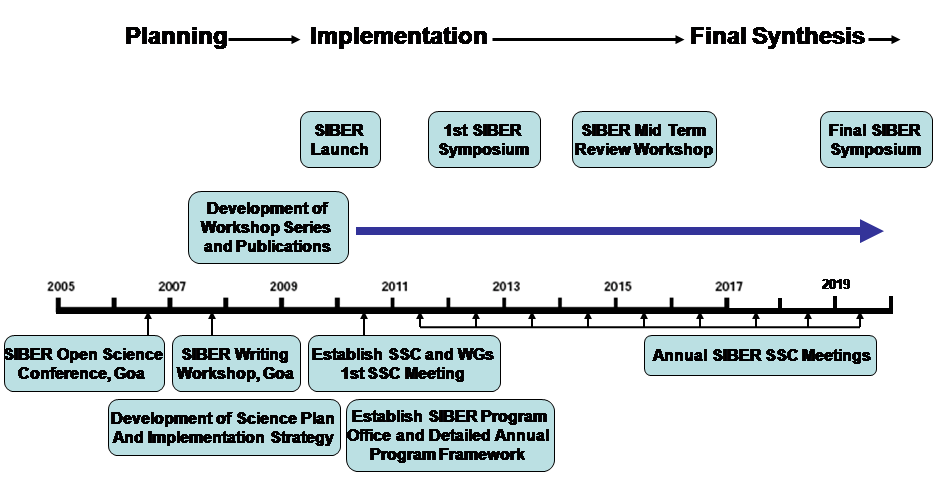
SIBER has built a multidisciplinary network of experts that will grow throughout the program. Through the SSC and WGs, SIBER will convene regular meetings, workshops, scientific sessions and ultimately scientific conferences as per the timeline given below. The annual SSC meetings help develop aspects of the work plan for each of the six SIBER themes. Subsequent events will build on these to develop new approaches and to advance the integration process. These events will occur at regular periods as noted in the timeline. Other activities such as direct research, development of online tools, publications and model development will take place throughout the program and will feed into the workshops and meetings as appropriate.
SIBER INDIA
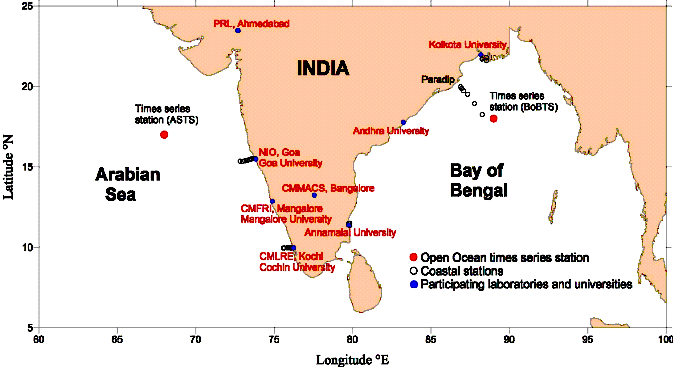
SIBER INDIA was initiated as major national programme by Dr. Wajih Naqvi at a workshop held at National Institute of Oceanography (NIO) Goa in April 13-14, 2009. This programme is sponsored by Ministry of Earth Sciences (MoES), Government of India and has got strong national participation. SIBER INDIA programme has been subdivided into two major groups: Open Ocean and Esturies and Coastal Ocean. Open Ocean cluster has 6 projects and Easturies and Coastal Ocean cluster has 8 projects.
Details of the Projects are as follows:
Open Ocean Projects
S.No
Project Leader(Institute/University)
Project Title
1
Dr. S.W.A. Naqvi National Institute of Oceanography, GOA,
Long-term monitoring of oceanographic, biogeochemical and ecological processes in the North Indian Ocean through establishment of open-ocean time series stations in the Arabian Sea and Bay of Bengal
2.
Dr. N. Ramaiah National Institute of Oceanography, GOA
Elucidation of long-term changes in microbial communities in intensely denitrifying and oligotrophic environs through metagenomic analyses.
3.
Dr. Sujitha Thomas Central Marine Fisheries Research Institute, Mangalore
Flow of matter through trophic levels and biogeochemical cycles in marine and estuarine ecosystems
4.
Dr. R. Rengarajan Physical Research Laboratory, Ahmedabad
Particulate organic carbon export flux from upper Arabian Sea and Bay of Bengal using 234th as a tracer
5.
Prof. R. Ramesh Physical Research Laboratory, Ahmedabad.
The role of anaerobic ammonium oxidation (anammox) in nitrogen-loss from the Arabian Sea.
6.
Dr. M.K. Sharada C-MMACS, Bangalore
Modelling of marine biogeochemical cycles in the Indian Ocean
Esturies and Coastal Ocean Projects
S.No
Project Leader(Institute/University)
Project Title
1
Dr. SWA Naqvi National Institute of Oceanography Dona Paula-Goa
Dynamics of selected biogenic elements in Indian estuaries - A case study of the Mandovi - Zuari estuarine system
2
Prof. C Annapurna Department of Zoology, Andhra University, Visakhapatname
Assessing macro and meiobenthic diversity off Goa Coast with special emphasis on OMZ
3
Dr. Vishnu Murty Matta Department of Marine Sciences, Goa University
Atmospheric deposition and its influence on nutrients in coastal waters of Goa- West coast of India
4
Dr. B.R. Manjunatha Department of Marine Geology, Mangalore University
Assessing the Anthropogenic Impact on South-West Coast of India
5
Dr. A.A. Mohamed Hatha School of Marine Sciences,Cochin University of Science and Technology,Cochin
Role of Heterotrophic Bacteria and Cyanobacteria in the Nitrogen Cycle in the Cochin estuary and coastal waters with Special Reference to Nitrification, Denitrification and Nitrogen Fixing capabilities
6
Dr. V.N. Sanjeevan Centre for Marine Living Resources and Ecology, Kochi
Time-Series studies on the Biogeochemical aspects in the estuarine and coastal waters of Kochi, southwest coast of India
7
Dr. T. Balasubramanian Centre of Advanced Study in Marine Biology, Annamalai University, Parangipettai, Tamilnadu
Hydro - Biological studies of Vellar - Coleroon estuarine system
8
Dr. S. K. Mukhopadhyay Department of Marine Science,University of Calcutta
Biogeochemical dynamics of the Hooghly-Matla estuarine systems along the northeast coast of the Bay of Bengal, India.
SIBER workshop in Goa in IMBER Update, issue#5, December 2006
Members
Name
Position
Affiliation
Expertise
Address
Images
Greg Cowie
Chair, SIBER
University of Edinburgh, UK
Benthic Biogeochemistry
John Murray Laboratories, The King's Buildings, West Mains Road, Edinburgh EH9 3JW Email: Dr.Greg.Cowie@ed.ac.uk Phone: +44 (0) 131 650 8502 FAX: +44 (0) 131 668 3184 http://www.ed.ac.uk/
Raleigh Hood
Co-Chair,SIBER
University of Maryland, Cambridge, USA
Biogeochemical modelling
Horn Point Laboratory, Centre for Environmental Sciences University of Maryland P.O. Box 775
Cambridge, MD 21613 USA Email: rhood@umces.edu Phone: 410-221-8434
Fax: 410-228-3890 http://www.umces.edu/hpl/people/rhood
Michael Roberts
Professor
Research Chair: Ocean Science and Marine Food Security
Partnered by
Newton Fund-British Council UK and National Research Foundation SA
Nelson Mandela Metropolitan University (Port Elizabeth)
University of Southampton + National Oceanography Centre (UK)
Physical Oceanography
Nelson Mandela Metropolitan University, Port Elizabeth and George, South Africa Email: Mike.Roberts@nmmu.ac.za
Lynnath Beckley
Professor
Murdoch University, Australia
Marine management/ fish and higher trophic levels
School of Environmental Science, Murdoch University, South St, Murdoch, Perth, Western Australia 6150 E-mail: L.Beckley@murdoch.edu.au Ph: (08) 9360 2488, Fax: (08) 9310 4997 http://www.environment.murdoch.edu.au/
P.N.Vinayachandran
Professor
Centre for Atmospheric & Oceanic Sciences (CAOS) Indian Institute of Science (IISc)
Physical Oceanography
Centre for Atmospheric & Oceanic Sciences (CAOS) Indian Institute of Science (IISc) Bangalore - 560 012. Tel: +91-80-2293 3065 Fax: +91-80-2360 0865
India Email: vinay@caos.iisc.ernet.in pn.vinayachandran@gmail.com
Dwi Susanto
Senior Research Scientist
University of Maryland, College Park, USA and Surya University, Tangerang, Indonesia
Physical oceanography, remote sensing
R. Dwi Susanto, PhD Department of Atmospheric and Oceanic Science University of Maryland, College Park, MD 20742, USA E-mail:dwisusa@umd.edu http://www.atmos.umd.edu/~dwi
Michael Landry
Professor of Oceanography
Scripps Institution of Oceanography, USA
Physical-biological coupling/ Zooplankton and food web dynamics
University of California, San Diego, USA Email: mlandry@ucsd.edu
Birgit Gaye
Research Scientist
Institute for Biogeochemistry and Marine Research Bundesstrabe
Marine Biogeochemistry
Institute for Biogeochemistry and Marine Research Bundesstrabe 55 D-20146 Hamburg, GERMANY Email: birgit.gaye@zmaw.de
Makio Honda
Principal Research Scientist
Japan Agency for Marine-Earth Science and Technology (JAMSTEC), Japan
Marine Biogeochemical Cycle
Japan Agency for Marine-Earth Science and Technology (JAMSTEC) Research Institute for Global Change(RIGC) Environmental Biogeochemical Cycle Research Program (EBCRP) 2-15 Natsushima, Yokosuka, 237-0061, Japan Email:hondam@jamstec.go.jp TEL+81-46-867-9502
Jenny Huggett
Marine Scientist
Oceans and Coasts Research, Department of Environment Affairs, Cape Town, South Africa
Biological Oceanography
Department of Environmental Affairs: Oceans and Coasts, Chief Directorate: Oceans & Coastal Research, PO Box 52126, Victoria & Alfred Waterfront, Cape Town 8000, South Africa. Email: jhuggett@environment.gov.za 021-402-3174 (W)
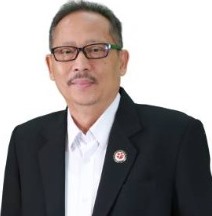
Ocky Karna Radjasa
Kepala Organisasi Riset Kebumian dan Maritim Badan Riset dan Inovasi Nasional (BRIN)
Kepala Organisasi Riset Kebumian dan Maritim Badan Riset dan Inovasi Nasional (BRIN), Indonesia Email:ocky001@brin.go.id
Francis Marsac
IRD (Institut de Recherche pour le Developpement) Department of Oceanography University of Cape Town
UMR 212 Exploited Marine Ecosystems
RW James Building University Avenue University of Cape Town Rondebosch, 7701, RSA
Minderoo Foundation Australia
Email:eraes@minderoo.org
EMERITUS Members
Hiroshi Kitazato
Program Director, Research Program for Paleoenvironment, Institute for Research on Earth Evolution, Japan Agency for Marine-Earth Science and Technology,
Japan Agency for Marine-Earth Science and Technology (JAMSTEC), JAPAN
Biology and ecology of deep-sea meiobenthos
Research Director, Institute of Biogeosciences, Japan Agency for Marine-Earth Science and Technology (JAMSTEC) 2-15 Natsushimacho, Yokosuka 237-0061 JAPAN Email: kitazatoh@jamstec.go.jp http://www.environment.murdoch.edu.au/
S.Wajih A.Naqvi
Scientist 'H'/ Co-chair, SIBER
National Institute of Oceanography, Dona Paula-Goa, INDIA
Biogeochemistry, N-cycling
National Institute of Oceanography Dona Paula-Goa, 403 004, INDIA E-mail: naqvi@nio.org Phone: 91-0832-2450294 Fax: 91-0832-2450607 http://www.nio.org/
EX SSC Members
M.Ravichandran
Director
National Centre for Antarctic and Ocean Research (NCAOR), India
Physical oceanography
National Centre for Antarctic and Ocean Research (NCAOR),
Head Land Sada, Vasco-Da-Gama, Goa India Email: ravi@incois.gov.in
Adnan Al-Azri
SIBER Member, National contact
Sultan Qaboos University, Al-Khod, Oman
Phytoplankton and DOM dynamics
Department of Marine Science and Fisheries College of Agriculture and Marine Science Sultan Qaboos University Al-Khod 123 Oman Email: adnazri@squ.edu.om Phone: (+ 968) 2414 1254 Fax: (+ 968) 2441 3418 http://web.squ.edu.om/
Shiham Adam
CLIOTOP Representative
Marine Research Centre (MRC), Maldives
Head, Fisheries assessment and management
General Director Marine Research Centre (MRC) H. White Waves Moonlight Higun Male - 20025, Maldives E-mail: msadam@mrc.gov.mv
Mitrasen Bhikajee
IOGOOS Chair and Director, Mauritius Institute of Oceanography
Mauritius Institute of Oceanography
Marine Biology
Mauritius Institute of Oceanography(MOI), France Centre,Victoria Avenue, Quatre-Bornes, Mauritius. E-mail: bhikajee@intnet.mu Tel:(230)427 4434 Fax:(230)427 4433 http://www.unesco.org/
David Vosuden
Project Director, Agulhas and Somali Current Large Marine Ecosystem Project (ASCLME)
ASCLME, Grahamstown, South Africa
Human impacts and management
ASCLME House 18 Somerset Street Private Bag 1015 Grahamstown 6140 South Africa Email:david.vousden@asclme.org Telephone: +27 46 636 2984 Fax: +27 46 622 6621
Catherine Goyet
Professor
CEFREM, Universite de Perpignan, France
Carbon cycling, biogeochemistry
CEFREM, CNRS UMR 5110 Universite de Perpignan 52, av de Villeneuve F-66860 Perpignan France Email: cgoyet@univ-perp.fr Phone: +33 468 66 1743 Fax: +33 468 66 2096 http://cdiac.ornl.gov/
King Abdullah University of Science and Technology
Director of the Red Sea Research Center 4700 King Abdullah University of Science and Technology
Director of the Red Sea Research Center 4700 King Abdullah University of Science and Technology Thuwal 23955-6900 Kingdom of Saudi Arabia Email:xabier.irigoyen@kaust.edu.sa
Goals & Objectives
The Long term goal of SIBER is to understand the role of the Indian Ocean in global biogeochemical cycles and the interaction between these cycles and marine ecosystem dynamics. This understanding will be required in order to predict the impacts of climate change, eutrophication and harvesting on the global oceans and the Earth System and it is fundamental to policy makers in the development of management strategies for the Indian Ocean. To address this goal, emphasis will be given to the analysis required to predict and evaluate the impacts of physical and anthropogenic forcing on biogeochemical cycles and ecosystem dynamics in the Indian Ocean. SIBER will leverage the sampling and monitoring activities of several coastal and open-ocean observing systems that are being planned and deployed in the Indian Ocean and it will provide the basin-wide scientific coordination and communication required to predict Indian Ocean biogeochemical cycles and ecosystem dynamics in the context of climate change and other anthropogenic influences.
Publications
Publications
Hood, R
and Beckley, L (2019) The second international Indian
Ocean Expedition (IIOE-2): Motivating new exploration in a poorly
understood ocean basin (Volume 1); Deep-Research Part II, Topical Studies in Oceanography, 161, 2-4
Singh, R, Sautya, S and Ingole B (2019) The community structure of the
deep-sea nematode community associated with polymetallic nodules in the
Central Indian Ocean Basin, Deep-Research Part II, Topical Studies in Oceanography, 161,
16-28.
White, C, Woulds, C, Cowie G, Stott, A and Kitazato, H
(2019) Resilience of benthic ecosystem C-cycling to future changes in
dissolved oxygen availability, Deep-Research Part II, Topical Studies in Oceanography, 161,
29-37.
Saalim, SM, Saraswat, R, Suokhrie, T and Nigam, R (2019) Assessing the
ecological preferences of agglutinated benthic foraminiferal morphogroups
from the western Bay of Bengal, Deep-Research Part II, Topical Studies in Oceanography, 161,
38-51.
Mao, H, Feng, M, Phillips, H and Lian, S (2019) Mesoscale eddy
characteristics in the interior subtropical southeast Indian Ocean, tracked
from the Leeuwin Current system, Deep-Research Part II, Topical Studies in Oceanography, 161,
52-62.
Prend, CJ, Seo, H, Weller, R and Farrar, J (2019) Impact of freshwater
plumes on intraseasonal upper ocean variability in the Bay of Bengal, Deep-Research Part II, Topical Studies in Oceanography, 161,
63-71.
Al-Yamani, F, Naqvi, SWA (2019) Chemical oceanography of
the Arabian Gulf, Deep-Research Part II, Topical Studies in Oceanography, 161,72-80.
Baer, SE Rauschenberg, S, Garcia, CA, Garcia, NS and Lomas, MW (2019)
Carbon and nitrogen productivity during spring in the oligotrophic Indian
Ocean along the GO-SHIP IO9N transect, Deep-Research Part II, Topical Studies in Oceanography, 161,
81-91.
Beckley, LE,
Holliday, D, A.L. Sutton, AL, Weller, E and Thompson, PA (2019) Structuring
of larval fish assemblages along a coastal-oceanic gradient in the
macro-tidal, tropical Eastern Indian Ocean, Deep-Research Part II, Topical Studies in Oceanography, 161,
105-119.
Miller, MJ, Wouthuyzen, S, Feunteun, E, Aoyama, J, Tsukamoto, K (2019)
Contrasting biodiversity of eel larvae across the central Indian Ocean
subtropical gyre, Deep-Research Part II, Topical Studies in Oceanography, 161,
120-131.
Dreo, R, Bouffaut, L, Leroy, E, Barruol, G and Samaran, F (2019) Baleen
whale distribution and seasonal occurrence revealed by an ocean bottom
seismometer network in the Western Indian Ocean, Deep-Research Part II, Topical Studies in Oceanography, 161,
132-144.
Rixen, T
, Gaye, B, Emeis, K-C and Ramaswamy, V (2019) The ballast
effect of lithogenic matter and its influences on the carbon fluxes in the
Indian Ocean,Biogeosciences, 16, 485-503.
Burdanowitz, N, Gaye, B, Hilbig, L, Lahajnar, N, Luckge,
A, Rixen, T and Emeis, K-C (2019) Holocene monsoon and sea
level-related changes of sedimentation in the northeastern Arabian Sea, Deep-Sea Research Part II,
https://doi.org/10.1016/j.dsr2.2019.03.003.
Suntharalingam, P, Zamora, LM, Bange, HW, Bikkina, S, Buitenhuis, E,
Kanakidou, M, Lamarque, JF, Resplandy, L, Sarin, MM, Seitzinger, S and
Singh, A (2019, in press) Anthropogenic nitrogen inputs and impacts on
oceanic N2O fluxes in the northern Indian Ocean: The need for an integrated
observation and modelling approach, Deep-Sea Research Part II, Topical Studies in Oceanography,
https://doi.org/10.1016/j.dsr2.2019.03.007.
Rohith, B, Paul, A, Durand, F, Testut, L, S. Prerna, S, Afroosa, M,
S.S.V.S. Ramakrishna, SSVS and Shenoi SSC (2019) Basin-wide sea level
coherency in the tropical Indian Ocean driven by Madden-Julian Oscillation, Nature Communications, 10: 1257,
https://doi.org/10.1038/s41467-019-09243-5.
Van der Mheen, M., Pattiaratchi, C., and van Sebille, E. (2019) Role of
Indian Ocean dynamics on accumulation of buoyant debris, Journal of Geophysical Research: Oceans,124,
https://doi.org/10.1029/2018JC014806
Wojtasiewicz, B, Trull, TW, Udaya Bhaskar, TVS, Gauns, M, Trull, T, Udaya
Bhaskar, TVS, Prakash, S, Ravichandran,
M, Shenoy, DM, Slawinski, D, Hardman-Mountford, NJ, (2018) Autonomous
profiling float observations reveal the dynamics of deep biomass
distributions in the denitrifying oxygen minimum zone of the Arabian Sea
(2018)Journal of Marine Systems,
https://doi.org/10.1016/j.jmarsys.2018.07.002
.
Subrahmanyam, B, Trott, CB and Murty, VSN (2018) Detection of intraseasonal
oscillations in SMAP salinity in the Bay of Bengal , Geophysical Research Letters,
https://doi.org/10.1029/2018GL078662
Chakraborty, K, Nimit, K, Akhand, A, Prakash, S, Paul, A,
JayashreeGhosh, J, Udaya Bhaskar, TVS and Chanda, A (2018) Modeling the
enhancement of sea surface chlorophyll concentration during the cyclonic
events in the Arabian Sea,Journal of Sea Research, 40, 22 - 31.
https://doi.org/10.1016/j.seares.2018.07.003
Mahajan, A. S., Tinel, L., Sarkar, A., Chance, R., Carpenter, L. J.,
Hulswar, S., Mali, P., Prakash, S. and Vinayachandran, P.N. (2019) Understanding Iodine Chemistry
over the Northern and Equatorial Indian Ocean , Journal of Geophysical Research-Atmosphere,
doi.org/10.1029/2018JD029063
Srichandan, S., Baliarsingh, S.K., Prakash, S., Lotliker,
A.A., Parida, C., Sahu, K.C. (2019) Seasonal dynamics of phytoplankton in
response to environmental variables in contrasting coastal ecosystems, Environ Sci Pollut Res, 26(12), 12025-12041, doi:
10.1007/s11356-019-04569-5
Vidya, PJ and Kurian S (2018) Impact of 2015-2016 ENSO on the winter bloom
and associated phytoplankton community shift in the northeastern Arabian
Sea,Journal of Marine Systems, 186, 96-104,
https://doi.org/10.1016/j.jmarsys.2018.06.005
Sarma, VVSS and Udaya Bhaskar, TVS (2018) Ventilation of oxygen to Oxygen
Minimum Zone due to anticyclonic eddies in the Bay of Bengal, JGR Biogeosciences, 123, 2145-2153,
https://doi.org/10.1029/2018JG004447.
Martin, P, Federico M. Lauro, FM, Sarkar, A, Goodkin, N, Prakash, S, Vinayachandran, PN (2018)
Particulate polyphosphate and alkaline phosphatase activity across a
latitudinal transect in the tropical Indian Ocean, Limnology and Oceanography, doi: 10.1002/lno.10780.
WAITE, A.M., RAES, E., BECKLEY, L.E, THOMPSON, P.A.,
GRIFFIN, D., SAUNDERS, M., SAWSTROM, C., O'RORKE, R., WANG, M., LANDRUM,
J.P. & JEFFS, A. 2019. Production and ecosystem structure in cold-core
vs warm-core eddies: Implications for the zooplankton isoscape and rock
lobster larvae.Limnology & Oceanography doi.
10.1002/lno.11192
LANDRY, M.R
., BECKLEY, L.E. & MUHLING, B.A. 2019. Climate
sensitivities and uncertainties in food-web pathways supporting larval
bluefin tuna in subtropical oligotrophic oceans. ICES Journal of Marine Science 76(2), 359-369.
BECKLEY, L.E
., HOLLIDAY, D., SUTTON, A.L., WELLER, E., OLIVAR, M.P., THOMPSON, P.A.
2019. Structuring of larval fish assemblages along a coastal-oceanic
gradient in the macro-tidal, tropical Eastern Indian Ocean. Deep Sea Research Part II. 161:105-119.
SMITH, J.A., MISKIEWICZ, A.G., BECKLEY, L.E., EVERETT,
J.D., GARCIA, V., GRAY, C.A., HOLLIDAY, D., JORDAN, A.R., KEANE, J.,
LARA-LOPEZ, A., LEIS, J.M., MATIS, P.A., MUHLING, B.A., NEIRA, F.J.,
RICHARDSON, A.J., SMITH, K.A., SWADLING, K.M., SYAHAILATUA, A., TAYLOR,
M.D., VAN RUTH, P.D., WARD, T.M. & SUTHERS, I.M. 2018. A database of
marine larval fish assemblages in Australian temperate and tropical waters. Scientific Data 5:180207. doi.10.1038/sdata.2018.207.
de Lecea A, Coppin R, Noyon M, Huggett J (2018)
Zooplankton adrift: Investigating transportation by cyclonic eddy. Marine Biology Research, 14: 436-477. DOI:
10.1080/17451000.2018.1426862.
Noyon M, Morris T, Walker D, Huggett J (2018) Plankton
distribution within a young cyclonic eddy off south-western Madagascar. Deep Sea Research Part II,
https://doi.org/10.1016/j.dsr2.2018.11.001
Forke, S., Rixen, T., Burdanowitz, N., Luckge, A.,
Ramaswamy, V., Munz, P., Wilhelms-Dick, D., Vogt, C., Kasten, S., Gaye, B., 2019. Sources of laminated sediments in the
northeastern Arabian Sea off Pakistan and implications for sediment
transport mechanisms during the late Holocene.Holocene, 29,
130-144.
Noyon M, Rasoloarijao Z, Huggett J, Roberts M, Ternon J-F
(submitted) Comparison of mesozooplankton communities at three
shallow seamounts in the South West Indian Ocean. Deep Sea Research Part II.
Nimit, K., Nagaraja Kumar, M., Berger, A. M., Bright, R.P., Prakash, S., Udayabhaskar TVS, Srinivasa Kumar, T., Rohit,
P., Tiburtius, A., Ghosh, S. and Varghese, S. P. (2020) Oceanographic
preferences of yellowfin tuna (Thunnus albacares) in warm stratified
oceans: A remote sensing approach, International Journal of Remote Sensing,
10.1080/01431161.2019.1707903
Srichandan, S,. Prakash, S,. Baliarsingh, S. K., Lotliker,
A. A. And Sahu, K.C. (2019) A review on variability of partial pressure of
carbon dioxide in coastal waters of India, International Journal of Energy and Water Resources,
DOI:10.1007/s42108-019-00041-9
Chatterjee, A., Praveen Kumar, B., Prakash, S., Singh, P.
(2019) Annihilation of the Somali upwelling system during summer monsoon, Scientific Reports, DOI: 10.1038/s41598-019-44099-1
Roemmich et al., (2019) On the Future of Argo: A Global, Full-Depth,
Multi-Disciplinary Array, Review Article, Frontiers in Marine Science, DOI: 10.3389/fmars.2019.00439
Danish, M., Tripathy, G.R., Rajani, P., Gandhi, N., Prakash, S. (2019) Dissolved Boron in a brackish-water
lagoon system (Chilika Lagoon, India): spatial distribution and coastal
behavior,Marine Chemistry, Doi: 10.1016/j.marchem.2019.103663
Srichandan, S., Baliarsingh, S.K., Prakash, S., Panigrahy, R.C., Sahu, K.C. (2018) Zooplankton
Research in Indian Seas: A Review, Journal of Ocean University of China, 17(5),
1149-1158,DOI: 10.1007/s11802-018-3463-4
INCOIS | Indian National Centre for Ocean Information Services


 Message Board