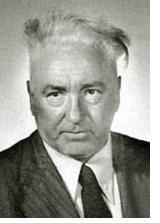
 Reich studied at the Psychoanalytical Institute in Berlin and in 1924 received an appointment to the Psychoanalytical Institute of Vienna.
Psychologist, b. 24 March 1897 (Dobrzcynica, Galicia, Austria-Hungary [in today's Ukraine]), d. 3 November 1957 (Lewisburg, Pennsylvania, USA).
Reich studied at the Psychoanalytical Institute in Berlin and in 1924 received an appointment to the Psychoanalytical Institute of Vienna.
The period between the two World Wars was dominated by the conflict between imperialism and communism. The emergence of socialist materialism at a time of great economic crisis in the capitalist world led to a general crisis of the traditional ideology and a questioning of religious attitudes and social taboos.
Reich's first published work, The function of the Orgasm of 1927, was a first step in his attempt to combine socialist politics with sexual education and freedom. In it Reich argued that the ability to achieve orgasm is an essential attribute of the healthy individual and that neurosis is caused by failure to achieve orgasm.
In his psychoanalytical work Reich concentrated on the overall structure of the human character rather than individual symptoms. His second work, Characteranalyse (Character Analysis) of 1933, described character as a protective armour against the discovery of underlying neuroses. In The Mass Psychology of Fascism (1933) he developed this into a theory of mass neurosis.
By that time, however, he had already broken with the psychoanalytic movement and began to venture into pseudo-scientific theories. He promoted the existence of "orgones," units of pre-atomic (mass-free) energy found in living organisms, the earth, and the atmosphere and space.
After Hitler's rise to power in 1933 Reich had to flee Germany and developed his "orgone science" or "orgonomy" in Scandinavia. In 1939 he emigrated to the USA and established an orgone centre in Langeley, Maine, which began to sell "orgone accumulators."
In 1954 the Food and Drug Administration of the USA sought and obtained a court injunction that banned the transport of orgone accumulators across state lines. When an associate disobeyed the injunction Reich was taken to court. Convicted of contempt of court and sentenced to two years in jail, he died a few months before possible release from jail on good behaviour. The Food and Drug Administration burnt his books in incinerators. It repeated the burning in the 1960s.
Reich's pseudo-science lives on through the Wilhelm Reich Museum at Orgonon in Langeley, an institution set up in accordance with his will. The Orgone Energy Observatory, designed for Reich in 1948, is on the National Register of Historic Places.
Kelly, C. R. (1999) What is orgone energy? Public Orgonomic Research Exchange (PORE) http://www.orgone.org/aaintro00.htm (accessed 5 August 2004)
Wilhelm Reich Museum (2004) Wilhelm Reich. http://www.wilhelmreichmuseum.org/ (accessed 5 August 2004)