Abraham Lincoln
President of the USA during the Civil War, b. 12 February 1809 (Hodgenville, USA), d. 15 April 1865 (Washington, D.C.).
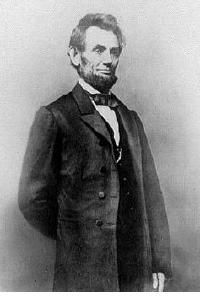 Lincoln's father had migrated from England in 1637 as a weaver's apprentice and moved west as a "pioneer". Abraham was born in a settler's cabin in Kentucky. When he was seven years old he moved with his parents to Indiana and shared the hard life in a "frontier state", clearing the land on which the family squatted. He had little time to attend school - all in all he spent maybe one year at schools - but a great thirst for reading and went to any length to borrow a book.
In 1830 the family moved to Illinois, the 21 year old Abraham driving the team of oxen. Not wanting to stay in farming, Lincoln worked on the railways, on Mississippi boats, as a storekeeper, postman and surveyor. In 1832 he participated as an army volunteer in a war against the Sauk and Fox Indians, who under their leader Black Hawk resisted the taking over of their cornfields and destruction of their settlements. (The war ended with the massacre at the Bad Axe River in Wisconsin where most of the Indians, including women and children, were killed, and the expropriation of the Sauk and Fox lands in Illinois; Lincoln later said that he himself had not met "live, fighting Indians" but "a good many bloody struggles with the mosquitoes.")
In his spare time Lincoln taught himself grammar, mathematics and law. In 1836 he passed the bar examination and set up office as a lawyer in Springfield, Illinois. Travelling across the frontier areas on horseback or in horse-drawn buggy he became a successful "prairie lawyer" and earned more money than the district judges. His hard life ended when he became an attorney for a railroad company. He worked for banks, insurance companies and industry and as a patent lawyer.
In 1834 Lincoln was elected to the Illinois State Legislature. For twenty years his political activity had no impact on the national level. The change came in 1854. The USA then consisted of three regions, the industrialising capitalist society of the north, the slave society of the south, and the western territories which still had to be taken from the Indians. How the territories were to be "developed" was the subject of intense debate. In 1854 a bill of Congress introduced slavery in Louisiana and allowed slavery in Kansas and Nebraska if its people decided to introduce it. The industrial north was violently opposed to the introduction of slavery in the territories, which it wanted to open up with new railroads and free labour.
Lincoln was on the side of the railroad companies and loathed by the southern states. When he was elected president of the USA in 1860 South Carolina declared its withdrawal from the United States. It was joined by six other states to form the Confederate States of America. Lincoln was determined to maintain the unity of the USA, and the Civil War began between the south, defender of the expansion of slavery, and the north, which wanted to limit slavery to the southern states. Four more states joined the Confederation in the course of the war.
Lincoln's war strategy was not immediately successful. In September 1862 (in final form in January 1863) he introduced the Emancipation Proclamation as a war measure. It declared the end of slavery in the Confederate states (but not in those slave states that had remained loyal to the Union) and secured its permanence by the introduction of the Thirteenth Amendement to the Constitution, which banned slavery from the territory of the USA. As a result he was re-elected with a greater majority, and the war was finally won by the Union in 1865. Lincoln did not see the end of the war; he was assassinated during a theatre visit twelve days before the surrender of the Confederate States.
In the USA Lincoln is considered a national hero; statues and memorials of him can be found in every major town, and he is one of four presidents carved into Mount Rushmore. The Lincoln Memorial in Washington, D.C, with its more than 6m tall statue was built in 1915 - 1922, fifty years after the end of the Civil War.
Lincoln is rightly seen as the symbol of the "American dream", in which even the humblest squatter can become president if he has Lincoln's tenacity and immense intellectual gift. He is also seen as the man who ended slavery in the USA. Two paintings on the Lincoln Memorial depict Reunion and Progress and Emancipation of a Race. Lincoln's violent death strongly contributed to his standing as a national hero.
Lincoln certainly abhorred slavery; he remembered the sight of "ten or a dozen slaves, shackled together with irons" during a boat trip as "a continual torment to me". But he did not see the end of slavery as a necessity. His one and only aim was to maintain the unity of the USA as a favourable condition for further industrial progress: "If I could save the Union without freeing any slave I would do it," he wrote, "and if I could save it by freeing all slaves, I would do it; and if I could save it by freeing some slaves and leaving others alone, I would also do that."
At some stage Lincoln considered freeing all four million slaves and deporting them all to Africa, a plan that he abandoned as impractical. Towards the end of the Civil War he strongly opposed plans of the radical faction of his Republican party to confiscate slavery estates and turn them over to the freed slaves themselves.
If Lincoln is to be judged in the context of world history his memory will continue as an upright and honest president who engineered the necessary transition from slave society to capitalism in the southern states of the USA. His presidency lead to the Thirteenth Amendment, which brought the end of slavery. In the process he achieved the "emancipation of the black race" and laid the conditions for the final expropriation of the Indian nations.
Reference
Current, R. N. (1995) Abraham Lincoln, Encyclopaedia Britannica 15th ed.
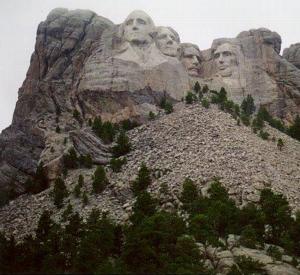
Mount Rushmore National Memorial in South Dakota, USA.
The 20m high heads show the presidents (from left to right) George Washington, Thomas Jefferson, Theodore Roosevelt and Abraham Lincoln. Work on the monument began in 1927 and continued with many interruptions until 1941. The rubble below are the leftovers from the carving process.

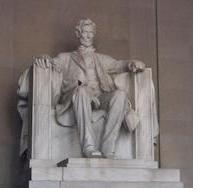 The Lincoln Memorial in Washington, D.C.
The memorial building is seen above, the statue of Abraham Lincoln, which faces the visitors through the columns when entering, is on the left. It is the work of Daniel Chester French and was dedicated in 1922. On the wall above Lincoln's head is the inscription
In this temple as in the hearts of the people for whom he saved the Union the memory of Abraham Lincoln is enshrined forever."
home