Tu Fu
Chinese poet, considered by many the greatest of all time, b. 712 (Hsiang-yang, China), d. 770 (Honan).
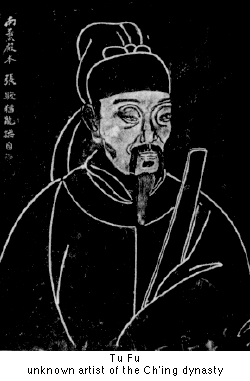 Tu Fu was the son of a familiy of scholars. He received the classical Confucian education, but when he sat for the imperial examinations in 736, he did not pass. He spent the following years travelling, meeting the poets of the time and writing poetry of his own. For a while, he travelled with the poet Li Po, who awakened his interest in Taoism; but after returning to the capital Hsiang-yang (in today's Honan province) Tu Fu turned away from Taoism and returned to classical Confucianism.
Back in the capital, Tu Fu tried a second time to pass the imperial examinations and failed again. Though without income and position, he had close connections with a group of high officials. Some time around 752 he managed through marriage to own a small farm and support himself.
Between 751 and 755 he tried to obtain a court position by submitting various literary works that, packed in words of flattery, were aimed at giving political advice. Eventually he was given a nominal position without duties.
When the An Lu-shan Rebellion broke out in 755 Tu Fu's closeness to the court caused him great suffering. He could escape persecution and joined the court in exile in 757. He became the imperial censor (a position role to oversee and criticize the conduct of government officials), but his reports to the emperor did not find favour, and he was dismissed.
Again without income or support, Tu Fu travelled again, more or less aimlessly, and had to live through extremely hard times - several of his children died from starvation.
During the 760s Tu Fu served a local warlord for some time. By 768 he was on the road again. He died while travelling, probably in Tan-chou. According to legend his death was caused from excessive eating and drinking after a fast of ten days.
Tu Fu's poetry covers a wide range of themes. In his early work he praised the beauty of nature and lamented the passing of time. He then turned to the affairs of men, writing bitter attacks on the nature of war and using biting satire to criticise the ruling class: In The Army Carts he talks about conscription of the poor. Beautiful Women condemns conspicuous luxurious consumption at the court. Finally, during the time of personal suffering, his work expressed deep compassion with the fate of ordinary people caught up in times of war.
Tu Fu's genius lies in his absolute mastery of the rules of classic verse, which was no limitation for him to reach absolute new heights in expression. His phrases achieve a denseness that exploits all possibilities of the Chinese intonation and is full of alluded overtones and connotations. This masterful use of the possibilities of intonation makes it virtually impossible to do his work justice in translation, although several attempts have been made. The quality of his lu shi ("regulated verse") could be sufficient reason why anyone would want to learn Chinese.
home